
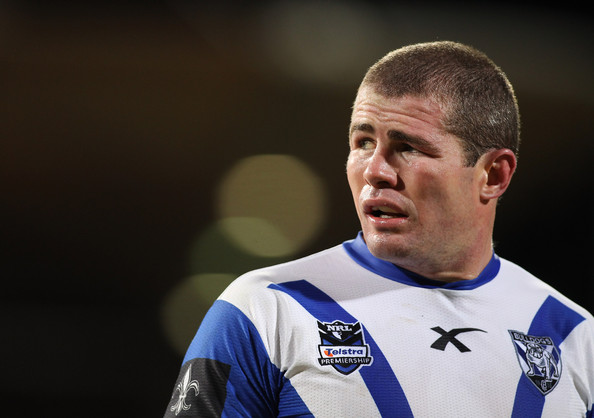
As we wait for season 2011 to get underway, the Making The Nut team will take a look back over the last 20 years to name the 20 best players at all sixteen teams. Merged teams will take account of both clubs pre-merger and the only rule is that a player must have played at least three years post-1990. A player’s time at the club is the only time that is taken into account.
Here, Nick Tedeschi ranks the Canterbury-Bankstown Bulldogs.
20. Tony Grimaldi
Never fashionable, Grimaldi rarely got the credit he deserved but he was the backbone of Canterbury’s 2004 premiership. The Bulldogs won 66.7% of games when he was on the field, one of the best strike rates of players ranked in the top twenty. There were few tougher or more professional Bulldogs and in an era where Canterbury’s values wavered, Grimaldi was one of the few links to the better days of the Peter Moore era.
19. Sonny Bill Williams
A treacherous c*nt with the morals of a herpes-infested prostitute on an ice binge, Williams will always be loathed by the Canterbury faithful. He was, however, a prodigious talent with a natural talent rarely seen.
18. Mark O’Meley
Recruited from the Northern Eagles, Canterbury got the best years out of O’Meley with Shrek playing 15 Test matches and eight Origins while in the blue and white. O’Meley was a fearless player who showed little regard for his own safety and added some real physicality to Canterbury’s pack in the middle part of the decade just gone.
17. Simon Gillies
Such was the respect Gillies was held in at Belmore, he was named as Terry Lamb’s successor and kept the captaincy even when Lamb returned in 1996. Gillies’ best season was 1995 when he turned in some spectacular finals performances, including a two-try effort against Canberra in the preliminary final where he starred from whistle-to-whistle. The Gillies years were predominantly unsuccessful and he finished his career in reserve grade in 1998 after a dramatic loss in form but at his best, he was a dangerous with the ball and gritty in defence. Played all three matches for the New South Wales Super League team in ’97.
16. David Stagg
Stagg has played only two seasons at Belmore but he has been a key figure in the Bulldogs’ transformation under the stewardship of Todd Greenberg. In the Grimaldi mould, Stagg is renowned for doing the unfashionable stuff and received due recognition of his contribution in 2009 when named Dally M Lock of the Year. Stagg is a workhorse who may be the best tackler Canterbury has ever known.
15. Dean Pay
One of the famous quartet who betrayed the club in 1995, Pay is no longer welcome at Canterbury. During his time at the club, however, Pay was arguably the best player in a quality pack. Pay played in two Grand Finals at Canterbury, winning in 1995, and made his Origin debut while at the club. Pay was renowned for his bruising defence and stamped that reputation in ink when breaking the ribs of Glenn Lazarus in the second week of the 1995 finals series. Canterbury won a remarkable 67.9% of matches when Pay played.
14. Jason Smith
The younger of the Smith brothers played only 62 matches for the Bulldogs but they were fruitful times with Canterbury winning 74.2% of games when the ultra-talented lock/five-eighth was on the field. Smith was instrumental in guiding Canterbury to the 1994 Grand Final and despite being dropped in 1995 for turning his back on the club, he came off the bench in the 1995 premiership victory. Smith made his debut for both Queensland and Australia as a Bulldog.
13. Willie Mason
As much of a trouble-maker as Mason always was at Belmore, he was capable of some outstanding performances. His 2004 Grand Final effort that was rewarded with the Clive Churchill Medal is testament to that. As are the 10 Origin and 23 Test jerseys he won while at Canterbury. They were eight long seasons but occasionally, just occasionally, Willie Mason was worth the trouble.
12. Nigel Vagana
In only three seasons at Canterbury, Vagana broke many of the club’s try-scoring records. In only 76 games, Vagana scored a remarkable 61 tries. His 23 tries in 2002 is a Canterbury club record while is 22 tries in 2003 sits second. His five-try haul against South Sydney in 2002 tied a club record that had stood for 60 years. Vagana won the Dally M Centre of the Year in 2001 and 2002 and was unlucky not to leave the Bulldogs with a premiership ring.
11. Darren Smith
Darren Smith had two stints at Canterbury and each time he oozed class, playing 19 Origin matches while at the club. Smith never played in a Grand Final for Canterbury (dropped in ’94 for signing with Brisbane, playing against Canterbury in ’98 and being part of the team thrown out in ’02) but was a wonderful centre/second-rower who had it all: strength, determination, skill, speed. Smith was awarded the Australian Sports Medal in 2000 for his contribution to rugby league.
10. Craig Polla-Mounter
Polla-Mounter was good enough to play Origin football but sadly, never received the call-up. That did not impact his high-level of play at Canterbury. The tough and feisty halfback came into his own in 1998 when a stellar performance in the preliminary final against Parramatta got Canterbury into their third Grand Final in five seasons. Polla-Mounter scored two tries and kicked two field goals but his finest moment came on the stroke of full-time when he nearly landed a 51-metre field goal that would have won Canterbury the match. Canterbury may have not been in the preliminary final if it wasn’t for Polla-Mounter: the nuggetty seven slotting the winning field goal against Illawarra in the last minutes of the last round to give Canterbury a 25-24 win and ninth spot on the ladder. In ten seasons, Polla-Mounter played 192 matches for Canterbury and never once shirked the task.
9. Daryl Halligan
Maligned by ignorant supporters of other clubs, Halligan was a beloved figure on the left wing at Canterbury. Without doubt one of the greatest kickers the game has ever known, Halligan kicked Canterbury to victory on more occasions that anyone cares to remember. Perhaps his two most famous moments came in big-time semi-final matches. Halligan calmly slotted the winning field goal against Canberra in the 1994 major semi-final and it was his sideline conversion that sent the 1998 preliminary final to extra-time. A safe pair of hands and a remarkable kick, Halligan topped the NRL point-scoring list in 1993 and 1994 and won the Dally M Winger of the Year in ’94.
8. Andrew Ryan
A deft backrower with sharp skills and a heart for a heavy workload, Ryan has been Canterbury to the core since transferring from Parramatta. Ryan will surpass 200 games for the club this season and another turnaround could see him win another Dally M Captain of the Year. In his first game as skipper of the Bulldogs, Ryan lifted the premiership trophy and he has been the unchallenged leader of the club ever since, now the second longest captain in Bulldogs history. For much of his time at the Bulldogs, Ryan was a representative staple.
7. Jason Hetherington
The 1998 Dally M Hooker of the Year was a fine player on both sides of the ball. A hearty defender and a creative ball-player, Hetherington deserved the Australian and Queensland jerseys he won. Hetherington was one of the top hookers of his generation and was critical to Canterbury making it to three deciders. Hetherington embodied the Bulldog spirit and his retirement coincided with a dramatic fall from grace for the much-lauded club.
6. Jim Dymock
Dymock played only three seasons at Canterbury but he was, with the exception of Terry Lamb, the key figure in the great run of success between 1993 and 1995. In his debut season at the club, Dymock was named the Dally M Lock of the Year as Canterbury won their first minor premiership in nine seasons. In his second year, he was one of Canterbury’s best, leading the blue and whites to the Grand Final. Dymock had his finest year in 1995, winning the Dally M Lock of the Year and more importantly the Clive Churchill Medal with his deft playmaking a sight to behold. Dymock left the club in sour circumstances afterwards but of the four traitors, he is the most fondly regarded after his brilliant effort in the ’95 premiership victory.
5. Luke Patten
It was a great shame that Luke Patten never got to represent New South Wales or Australia. His failure to win rep honours was more a reflection of the era he played in rather than his own ability. A decade in the blue and white netted him 225 games and 82 tries but his contribution can never be explained in numbers. In some turbulent times, The General was a rock. With the ball in hand, he was a menace. Under the high ball he was safe. Luke Patten was always a consummate professional.
4. Hazem El Masri
From 1993 when Daryl Halligan arrived through to the retirement of Hazem El Masri in 2009, Canterbury were blessed to have two of the greatest ever kickers. While Halligan was technically a better kicker, El Masri was a more accomplished player who had an amazing ability to get over the tryline, scoring 159 tries in his time at the club. Who knows how many points El Masri could have racked up had Halligan not been a regular during his first five seasons in the top grade. No player has donned the blue and white more often, he has scored more points in top grade league than any other player and he was as beloved as any Bulldog ever to pull on the famous colours. El Masri represented Australia and New South Wales but not nearly as often as was deserved, often maligned for his height and supposed lack of speed. Amazingly, El Masri was the top scorer in the NRL for six seasons.
3. Darren Britt
Canterburycaptain from 1998 through til 2001, Britt was a natural leader who led by example with his bullocking running and hard-hitting defence. Britt was rewarded with nine Test match jerseys but the moronic Origin selectors, no doubt led by Bob Fulton, ignored his persistent claims. In 168 games for the Bulldogs, Britt never took a backward step and never once put in a poor showing and led Canterbury forward in three Grand Finals, including two in his first two seasons.
2. Steve Price
The most tragic moment of the last decade in Canterbury history is the moronic Malcolm Noad allowing Steve Price to flee to the Warriors. Price is Canterbury to the core but as a result of Noad’s stupidity, the Bulldogs missed Price’s best years. That is not to say Canterbury did not get great service from Price, the Bulldogs skipper from 2002 to 2004 who won the Dally M Captain of the Year in both 2002 and 2004. As a weedy youngster from Queensland who scored a decisive try in the ’95 Grand Final, few would have imagined that Price would become one of the greatest prop forwards to ever play the game. He did, however, and had injury not robbed him of his final game, Price would have been the only player to step out in all four Canterbury Grand Finals of the last two decades. It was a sad way to go out but his contribution to Canterbury will never be forgotten.
1. Terry Lamb
There is no doubting that Terry Lamb is the greatest Bulldog of them all and he still displayed plenty of brilliance right up until his retirement in ’96. While Lamb did not play Origin or Test match football post-1990, Lamb was the central figure of Canterbury’s resurgence under Chris Anderson in the early nineties. No player had the instinctive sense of being in the right place at the right time more than Lamb and few players had his drive to win. He was a tough defender, a sharp ball-player and a very good kicker. He won the Dally M Five-Eighth of the year from ’91 to ’93 and was arguably the best player on the field in the 1995 Grand Final. He was certainly the best player over the course of the finals series with man-of-the-match performances against St George and Canberra. Age never wearied Lamb, who was a star right until his final match.